Top 10 Crypto Trading Platforms: Fees, Safety & Access
Disclosure: this page has no affiliate links. See how we review and rank.
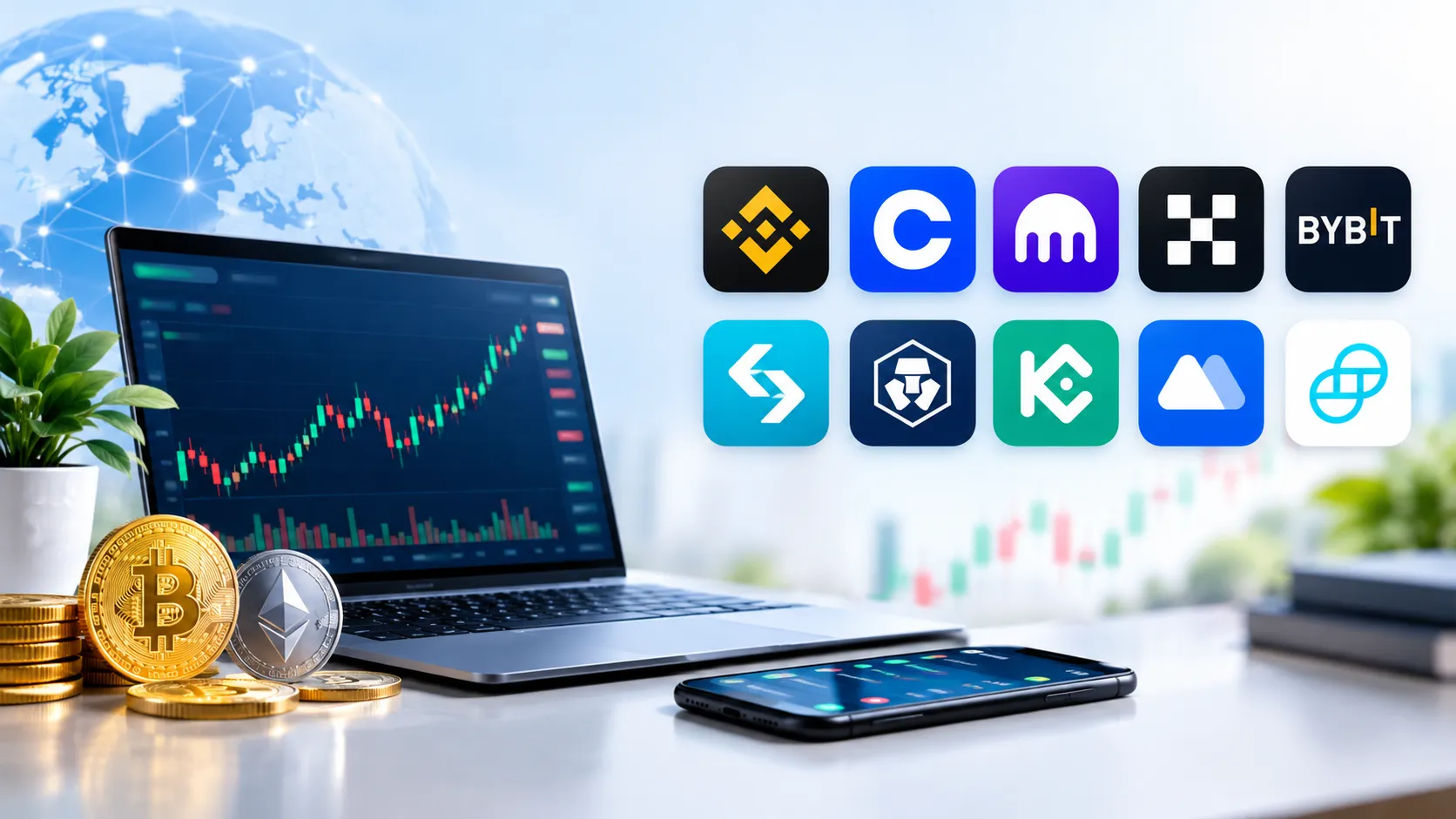
The top 10 crypto trading platforms are Binance, Coinbase, Kraken, OKX, Bybit, Bitget, Crypto.com, KuCoin, MEXC and Gemini. Binance leads on liquidity worldwide, while Kraken holds the cleanest security record of any exchange on this list.
Picking one comes down to 2 questions: what you’ll actually pay per trade, and whether the platform legally serves your country. Most rankings skip the second question. This one doesn’t. A cost breakdown for a $1,000 trade sits next to a country access table, and every major security incident gets its own row, all checked against public fee schedules and Proof of Reserves (PoR) reports in September 2026. If you live in the US, start with our top 10 crypto exchanges, which only lists platforms that serve American customers.
The Top 10 Crypto Trading Platforms at a Glance

Binance, OKX, Bybit, Bitget and KuCoin charge 0.10% or less on spot trades, while Gemini and Coinbase charge the most at the entry tier. Here’s the quick version of all 10, in ranked order.
- Binance
- Best for: global liquidity
- Spot fees: 0.10% maker / 0.10% taker
- Coins: 400+
- Founded: 2017
- Coinbase
- Best for: beginners
- Spot fees: 0.40% maker / 0.60% taker on Advanced
- Coins: 400+
- Founded: 2012
- Kraken
- Best for: security record
- Spot fees: 0.25% maker / 0.40% taker on Pro
- Coins: 780+
- Founded: 2011
- OKX
- Best for: advanced tools and Web3
- Spot fees: 0.08% maker / 0.10% taker
- Coins: 350+
- Founded: 2017
- Bybit
- Best for: derivatives
- Spot fees: 0.10% maker / 0.10% taker
- Coins: 730+
- Founded: 2018
- Bitget
- Best for: copy trading
- Spot fees: 0.10% maker / 0.10% taker
- Coins: 800+
- Founded: 2018
- Crypto.com
- Best for: mobile app and crypto card
- Spot fees: 0.25% maker / 0.50% taker on the Exchange
- Coins: 500+
- Founded: 2016
- KuCoin
- Best for: altcoins and trading bots
- Spot fees: 0.10% maker / 0.10% taker
- Coins: 700+
- Founded: 2017
- MEXC
- Best for: lowest fees and new listings
- Spot fees: 0% maker / 0.05% taker
- Coins: 2,000+
- Founded: 2018
- Gemini
- Best for: US compliance
- Spot fees: 0.60% maker / 1.20% taker on ActiveTrader
- Coins: 80+
- Founded: 2014
Fees shown are base-tier rates for accounts trading under $10,000 per month on each platform’s advanced or exchange interface.
The 10 Best Crypto Exchanges Reviewed
Each review covers fees, coin selection, the standout feature, and the main drawback. Platforms appear in ranked order.
1. Binance: Best for Global Liquidity
Binance is the best crypto trading platform for global liquidity, with the highest spot trading volume of any exchange worldwide. That volume matters once your orders reach five figures. A $20,000 Bitcoin (BTC) buy fills at close to the quoted price on Binance, while thinner books on smaller exchanges push the average price up through slippage.
Beginners get a stripped-down Lite mode in the app. Switch to Pro and the full order book appears, with charting and futures. Binance’s peer-to-peer (P2P) desk lets users in many emerging markets buy Tether (USDT) with local bank transfers, which is often the only practical on-ramp where card payments to exchanges fail.
Binance’s history isn’t spotless. Hackers stole 7,000 BTC in May 2019, and Binance covered the loss from its Secure Asset Fund for Users (SAFU). In November 2023, the company settled with US authorities for $4.3 billion, and founder Changpeng Zhao stepped down as CEO.
- Fees: 0.10% maker and taker, reduced when you pay fees in BNB
- Coins: 400+ tradable assets
- Standout feature: Deepest order books and a local-currency P2P market
- Drawback: Unavailable to US residents, who must use the separate Binance.US
2. Coinbase: Best for Beginners
Coinbase is the best crypto trading platform for beginners, combining a clean app with the oversight that comes from being a Nasdaq-listed company. Brian Armstrong and Fred Ehrsam founded it in 2012. In May 2025, it became the first crypto exchange added to the S&P 500. By the end of 2025, Coinbase held $376 billion in customer crypto, a scale no rival on this list publicly matches.
Buying through the simple Buy button costs more than it looks. In NerdWallet’s test, a $200 Bitcoin purchase through the basic interface cost 2.84% once the spread and flat fee were added together. Coinbase Advanced cuts that sharply, to 0.40% maker and 0.60% taker, and it’s free to switch.
Criminals bribed overseas support contractors to leak Coinbase account details, a breach the company disclosed in May 2025. No private keys or login credentials were taken, and Coinbase committed to reimbursing customers who were tricked into sending funds to the scammers.
- Fees: 0.40% maker / 0.60% taker on Coinbase Advanced
- Coins: 400+ tradable assets
- Standout feature: Beginner-friendly app backed by public-company disclosure rules
- Drawback: High costs on the simple-buy screen
3. Kraken: Best for Security and Transparency
Kraken has the strongest security record here, with no loss of client funds to a platform hack since Jesse Powell founded it in 2011. Kraken has published Merkle-tree Proof of Reserves since 2014. Few exchanges can point to a transparency record that long.
Security researchers exploited a bug in June 2024 and withdrew about $3 million from Kraken’s own treasury. Customer balances weren’t touched, and the funds were returned. Kraken holds a Markets in Crypto-Assets (MiCA) license in the EU through Ireland, and it serves most US states, with New York and Maine as the main exceptions.
Pricing is refreshingly clear. Instant buys cost a flat 1%, shown on the confirmation screen. Kraken Pro drops that to 0.25% maker and 0.40% taker for accounts under $10,000 in monthly volume, and it opens up 780+ coins with full charting tools.
- Fees: 0.25% maker / 0.40% taker on Kraken Pro; 1% on instant buys
- Coins: 780+ tradable assets
- Standout feature: Decade-long Proof of Reserves history
- Drawback: Relatively high Bitcoin withdrawal fees and minimums
4. OKX: Best for Advanced Tools and Web3
OKX is the strongest pick for experienced traders who want exchange tools and a self-custody Web3 wallet in one account. Grid bots and copy trading run inside the main app, and options traders can build multi-leg strategies there. The OKX Wallet connects to decentralized apps across 100+ blockchains without a separate download.
Spot fees start at 0.08% maker and 0.10% taker, among the lowest base rates on this list. OKX holds a MiCA license in the EU and relaunched in the US with a narrower coin menu. It publishes monthly Proof of Reserves reports. Run your own numbers through our crypto profit calculator to see what fees cost you.
Penalties topped $504 million when OKX pleaded guilty in the US in February 2025 to operating an unlicensed money-transmitting business. The case concerned compliance, not stolen funds.
- Fees: 0.08% maker / 0.10% taker
- Coins: 350+ tradable assets
- Standout feature: Built-in Web3 wallet covering 100+ chains
- Drawback: Steep learning curve for first-time users
5. Bybit: Best for Derivatives Trading
Bybit is the best crypto trading platform for derivatives, with perpetual futures at 0.02% maker and 0.055% taker plus options settled in USD Coin (USDC). Its matching engine rarely stalls during volatile sessions, a common complaint about smaller futures venues. Contracts on major pairs allow up to 100x margin, a level that can wipe out a position within minutes when the market moves against you. Size every leveraged trade with a position size calculator before you open it.
Dubai hosts Bybit’s headquarters, and the Virtual Assets Regulatory Authority (VARA) there supervises crypto firms, while EU users are served through a MiCA-licensed entity. On February 21, 2025, attackers drained roughly $1.5 billion in Ether (ETH) from a Bybit cold wallet. The FBI blamed North Korea’s Lazarus Group. Bybit replaced the missing ETH within days and kept processing withdrawals the whole time. Nobody lost money.
- Fees: 0.10% spot; 0.02% maker / 0.055% taker on futures
- Coins: 730+ tradable assets
- Standout feature: Options and futures on a high-uptime engine
- Drawback: Blocked in the US, UK, Canada and Japan
6. Bitget: Best for Copy Trading

Bitget is the best platform for copy trading, letting users mirror the positions of vetted traders automatically across spot and futures markets. Lead traders’ past returns and drawdowns are public before you commit a single dollar, and you can set a maximum loss per copied trade.
More than 800 assets fill the coin menu. Spot fees sit at 0.10% for both sides, lower when you pay in Bitget’s BGB token. Bitget publishes monthly Proof of Reserves and runs a dedicated protection fund, and it has no major breach of customer funds on record as of September 2026.
- Fees: 0.10% maker and taker, with BGB discounts
- Coins: 800+ tradable assets
- Standout feature: Transparent copy-trading leaderboard
- Drawback: Not licensed for US residents
7. Crypto.com: Best for Spending Crypto on Mobile
Crypto.com is the best mobile-first platform for spending crypto, pairing its trading app with Visa cards that pay cashback in Cronos (CRO). The company launched in Singapore in 2016 and holds a MiCA license in the EU through Malta.
Costs depend on which screen you use. The main app prices trades through a spread, while the Crypto.com Exchange charges 0.25% maker and 0.50% taker below $10,000 in monthly volume. More than 500 coins are available, and staking covers at least 24 assets.
Attackers pulled about $34 million in unauthorized withdrawals from 483 accounts in January 2022. Crypto.com reimbursed every affected user and replaced its two-factor authentication (2FA) system.
- Fees: 0.25% maker / 0.50% taker on the Exchange
- Coins: 500+ tradable assets
- Standout feature: Crypto Visa card with CRO rewards
- Drawback: Best perks require staking CRO, which adds price risk
8. KuCoin: Best for Altcoins and Trading Bots
KuCoin is the best exchange for altcoin hunters who want free trading bots, listing 700+ coins alongside built-in grid and dollar-cost-averaging (DCA) bots. Small-cap tokens often appear on KuCoin months before larger exchanges add them. For the largest coins, see the top 10 cryptocurrencies by market cap.
Holding KCS trims KuCoin’s 0.10% spot fee. The record carries 2 blemishes. A September 2020 hot-wallet hack took about $280 million, and KuCoin covered the losses while recovering most of the stolen funds. In January 2025, KuCoin pleaded guilty in the US to anti-money-laundering failures, paid about $297 million, and agreed to exit the US market for 2 years.
- Fees: 0.10% maker and taker, with KCS discounts
- Coins: 700+ tradable assets
- Standout feature: Free automated bots inside the app
- Drawback: No US access and a checkered compliance history
9. MEXC: Best for Low Fees and New Listings
MEXC offers the lowest spot fees and the largest coin menu on this list: 0% maker, 0.05% taker, and 2,000+ tokens. New projects frequently list on MEXC first. That’s the appeal and the danger, because many micro-cap tokens lose most of their value within weeks of launch.
Small accounts can trade without full Know Your Customer (KYC) verification, though withdrawal limits apply until you verify. MEXC doesn’t support direct fiat withdrawals, so cashing out means sending crypto to another exchange or selling it to a buyer on a P2P desk first. It holds no US, UK or Canadian license.
- Fees: 0% maker / 0.05% taker on spot
- Coins: 2,000+ tradable assets
- Standout feature: Earliest access to new token listings
- Drawback: Weak regulatory standing in major markets
10. Gemini: Best for US Compliance
Gemini is the most compliance-focused exchange for US traders, serving all 50 states as a New York trust company supervised by the New York State Department of Financial Services (NYDFS). Cameron and Tyler Winklevoss founded it in 2014, and Gemini listed on Nasdaq in September 2025.
Fees are the trade-off. Gemini’s ActiveTrader platform charges 0.60% maker and 1.20% taker below $10,000 in monthly volume, more than double Kraken’s rate at the same tier. The menu is limited to about 80 coins. When the Gemini Earn program froze during the 2022 market collapse, users waited until June 2024 for full repayment, and Gemini returned 100% of their assets.
- Fees: 0.60% maker / 1.20% taker on ActiveTrader
- Coins: 80+ tradable assets
- Standout feature: Availability in every US state
- Drawback: Highest entry-tier fees on this list
What Does a $1,000 Crypto Trade Cost on Each Platform?
A $1,000 market buy costs between $0.50 and $12.00 in trading fees across these 10 platforms, based on each exchange’s base-tier taker rate. The same percentages apply to euro and pound pairs, so a €1,000 or £1,000 trade carries an identical fee in that currency.
| Platform | Taker Fee | Fee on $1,000 | Fee on €1,000 |
| MEXC | 0.05% | $0.50 | €0.50 |
| Binance | 0.10% | $1.00 | €1.00 |
| OKX | 0.10% | $1.00 | €1.00 |
| Bybit | 0.10% | $1.00 | €1.00 |
| Bitget | 0.10% | $1.00 | €1.00 |
| KuCoin | 0.10% | $1.00 | €1.00 |
| Kraken Pro | 0.40% | $4.00 | €4.00 |
| Crypto.com Exchange | 0.50% | $5.00 | €5.00 |
| Coinbase Advanced | 0.60% | $6.00 | €6.00 |
| Gemini ActiveTrader | 1.20% | $12.00 | €12.00 |
Simple-buy screens cost more. Kraken’s instant buy charges a flat 1%, or $10 on $1,000. On Coinbase’s basic interface, a spread plus a flat fee apply, which is how NerdWallet’s small test purchase reached 2.84%.
Withdrawals add a second layer. Moving Bitcoin off an exchange costs a network fee on top of the platform’s charge. Bank withdrawals are usually free by domestic transfer, while wire transfers typically run $10 to $25 each.
Which Crypto Trading Platforms Work in Your Country?
Coinbase, Kraken and Gemini give the broadest US access on this list, while Binance, Bybit, Bitget, KuCoin and MEXC block US residents. EU users have the widest choice, because MiCA lets a single license cover all 27 member states.
| Platform | United States | United Kingdom | European Union | P2P Local-Currency Desk |
| Binance | No (Binance.US is separate) | Limited | Yes | Yes |
| Coinbase | Yes | Yes | Yes (MiCA) | No |
| Kraken | Yes, except NY and Maine | Yes | Yes (MiCA) | No |
| OKX | Yes, limited coins | Yes | Yes (MiCA) | Yes |
| Bybit | No | No | Yes (MiCA) | Yes |
| Bitget | No | Check | Check | Yes |
| Crypto.com | Yes, some limits in NY | Yes | Yes (MiCA) | No |
| KuCoin | No | Check | Check | Yes |
| MEXC | No | No | Check | Yes |
| Gemini | Yes, all 50 states | Yes | Yes (MiCA) | No |
“Check” means access varies or changed recently. Confirm on the platform’s restricted-jurisdictions page before depositing.
Traders in markets such as Pakistan, India and Nigeria often reach these platforms through P2P desks, since local banks frequently block card payments to exchanges. India requires any exchange serving Indian users to register with its Financial Intelligence Unit (FIU-IND). Rules shift fast in these markets, so check your national regulator’s list of approved or warned-against platforms before you deposit.
How Safe Are the Top Crypto Exchanges?
No exchange is risk-free, but 8 of these 10 publish Proof of Reserves reports showing customer assets backed 1:1. A Merkle-tree PoR lets you confirm that your own balance is included in the audited total without exposing anyone else’s account. Coinbase publishes audited financial statements as a public company instead, and Gemini relies on NYDFS trust-company oversight.
| Platform | Publishes PoR | Largest Incident | Outcome |
| Binance | Yes | May 2019: 7,000 BTC stolen | Covered by SAFU fund |
| Coinbase | Audited financials | May 2025: customer data leak | No keys taken; reimbursement pledged |
| Kraken | Yes, since 2014 | June 2024: ~$3M bug exploit | Treasury only; funds returned |
| OKX | Yes, monthly | Feb 2025: US guilty plea, $504M+ | Regulatory case; no funds lost |
| Bybit | Yes | Feb 2025: ~$1.5B ETH hack | Replaced within days; users made whole |
| Bitget | Yes, monthly | No major breach on record | Not applicable |
| Crypto.com | Yes | Jan 2022: ~$34M withdrawals | All users reimbursed |
| KuCoin | Yes | Sept 2020: ~$280M hack | Losses covered |
| MEXC | Yes | No major breach on record | Not applicable |
| Gemini | Trust oversight | 2022: Earn program freeze | 100% repaid by June 2024 |
Account-level habits cut your personal risk regardless of which exchange you use. Four settings matter most:
- Authenticator-app 2FA or passkeys instead of SMS codes, which SIM-swap attacks can intercept
- Withdrawal address whitelisting, so funds can only go to wallets you approved in advance
- Anti-phishing codes, which tag genuine exchange emails with a phrase you chose
- Cold wallets for long-term holdings, keeping only active trading balances on the exchange
Best Crypto Exchange by Trader Type
Coinbase is the best crypto exchange for first-time buyers, and Bybit is the best for futures traders. Match your main activity to the row below, then confirm the platform serves your country.
| Trader Type | Top Pick | Runner-Up | Why |
| Beginner buying BTC or ETH | Coinbase | Kraken | Simple apps with strong regulatory standing |
| Futures and options trader | Bybit | OKX | Low futures fees and USDC-settled options |
| Altcoin hunter | MEXC | KuCoin | 2,000+ and 700+ coins with early listings |
| Staking for yield | Kraken | Crypto.com | Wide staking menus with clear reward terms |
| Copy trader | Bitget | OKX | Public lead-trader stats and loss limits |
| Bot trader | KuCoin | OKX | Free grid and DCA bots inside the app |
| US resident | Kraken | Gemini | Licensed across most or all US states |
| Emerging-market trader | Binance | OKX | Local-currency P2P desks for deposits |
How to Choose a Crypto Trading Platform

To choose a crypto trading platform, check 5 factors in this order: legal access, security record, cost per trade, coin selection and deposit method. Order matters. A platform with rock-bottom fees is useless when it can freeze your account for serving your country without a license.
- Legal access: Confirm the exchange lists your country as supported, then look it up on your national regulator’s register, such as the UK’s Financial Conduct Authority (FCA) register or an EU member state’s MiCA list.
- Security record: Read how the exchange handled its worst incident. Bybit’s 2025 response, with full reimbursement within days, is the standard to compare others against.
- Cost per trade: Compare taker fees on the advanced interface, then add withdrawal costs. A 0.10% trading fee paired with a $25 wire withdrawal costs more on small accounts than a 0.40% fee with free transfers.
- Coin selection: Check that your target assets are listed before you open an account. Gemini’s 80 coins cover the majors, but altcoin traders need KuCoin’s 700+ or MEXC’s 2,000+.
- Deposit method: Match the platform to your banking options. Bank transfers carry the lowest fees, card deposits cost 2% to 4% on most exchanges, and P2P desks fill the gap where banks block exchange payments.
Expect identity checks on withdrawals, too. Under the Financial Action Task Force (FATF) Travel Rule, regulated exchanges collect sender and recipient details on crypto transfers above set thresholds. It’s the reason a withdrawal to a new external wallet sometimes triggers a short questionnaire. In the US, the GENIUS Act of 2025 set federal rules for stablecoin issuers, which affects how exchanges list and hold dollar-pegged tokens such as USDC.
How We Ranked the Top 10 Crypto Trading Platforms
We ranked the top 10 crypto trading platforms by scoring each one against 7 weighted criteria, with security and regulation carrying the largest share at 25%. The data came from each exchange’s published fee schedule, regulator registers, PoR reports, and public incident records, reviewed in September 2026.
| Criterion | Weight | What We Measured |
| Security and regulation | 25% | Licenses, PoR, incident history and response |
| Fees | 20% | Base-tier maker/taker, instant-buy and withdrawal costs |
| Global access | 15% | Number of major regions served, P2P availability |
| Coins and products | 15% | Tradable assets, futures, staking and bots |
| Liquidity | 10% | Spot volume and order book depth |
| App experience | 10% | Beginner and pro modes, mobile feature parity |
| Customer support | 5% | Live chat hours and response channels |
Affiliate relationships played no part in placement. Several widely promoted exchanges, such as Margex and WEEX, didn’t make the cut because they lack licenses in any major jurisdiction.
Conclusion: Which Crypto Exchange Should You Pick?
Pick Kraken or Coinbase if you live in the US or EU and value regulation, and pick Binance or OKX if you want the deepest global markets. Specialists have clearer matches. Futures traders get the most from Bybit’s derivatives engine, altcoin hunters belong on KuCoin or MEXC, and copy traders will find Bitget’s leaderboard the most transparent.
Start small, whichever platform wins. Deposit a modest amount, complete one trade, then withdraw to your own wallet before committing serious capital. That single round trip exposes the real fees and withdrawal speed, which no ranking of the top 10 crypto trading platforms can fully measure for you.
Risk disclaimer: Crypto assets are highly volatile and are not protected by the Federal Deposit Insurance Corporation (FDIC), the Securities Investor Protection Corporation (SIPC) or most national deposit schemes. This article is for information only and is not financial advice. Trade only on platforms licensed or authorized in your jurisdiction, and never invest money you can’t afford to lose.
Frequently Asked Questions About Crypto Trading Platforms

James
James leads crypto content at Crypto By Chance, covering exchanges, wallets, trading platforms, and blockchain technology. He researches trading fees, security features, market mechanics, and crypto regulations to explain a fast-moving market clearly. His guides and comparisons help readers evaluate their options, manage risk, and make informed decisions about digital assets.
Related Posts