Top 10 Crypto Coins by Market Cap: Ranked and Explained
Disclosure: this page has no affiliate links. See how we review and rank.
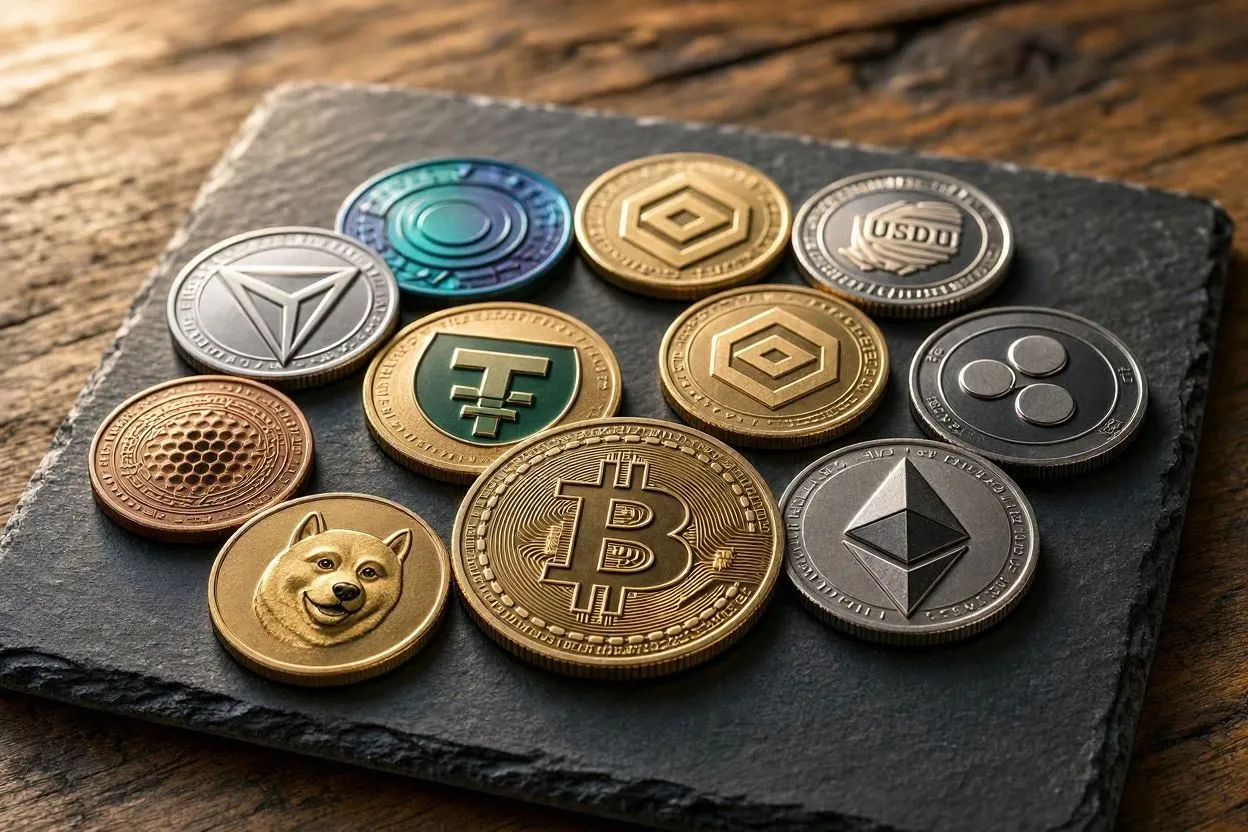
The top 10 crypto coins by market capitalization are Bitcoin (BTC), Ethereum (ETH), Tether (USDT), BNB, XRP, USD Coin (USDC), Solana (SOL), TRON (TRX), Zcash (ZEC), and Hyperliquid (HYPE), based on CoinMarketCap data from September 28, 2026. Together they’re worth roughly $2.59 trillion. That’s about 91% of a $2.85 trillion crypto market, and Bitcoin alone holds 58.6% of it.
Two of those ten, USDT and USDC, are stablecoins pegged to the U.S. dollar. They won’t grow in value. Strip them out and Dogecoin (DOGE) and Chainlink (LINK) complete the investable list. This guide explains what each coin does and where it breaks down, then shows how Americans buy these coins and report them to the Internal Revenue Service (IRS). You can buy all ten on the top 10 crypto exchanges that serve US investors.
Prices and market caps come from CoinMarketCap on September 28, 2026. Crypto trades around the clock, so figures shift by the minute. This article is for education and isn’t financial advice.
What Are the Top 10 Crypto Coins Right Now?
Bitcoin leads the top 10 crypto coins with a $1.66 trillion market cap, more than five times the size of second-place Ethereum. Each ranking reflects market capitalization, which is circulating supply multiplied by price.
| Rank | Coin | Launched | Supply Limit | How It Runs | Main Use |
| 1 | Bitcoin (BTC) | 2009 | 21 million coins | Proof-of-work mining | Store of value |
| 2 | Ethereum (ETH) | 2015 | No fixed cap (fee burn offsets issuance) | Proof-of-stake | Smart contracts and DeFi |
| 3 | Tether (USDT) | 2014 | No cap (minted against reserves) | Runs on other blockchains | Dollar stablecoin |
| 4 | BNB (BNB) | 2017 | Burning toward 100 million coins | Proof-of-staked-authority | Binance fees and BNB Chain gas |
| 5 | XRP (XRP) | 2012 | 100 billion coins, all pre-created | XRP Ledger consensus | Cross-border payments |
| 6 | USD Coin (USDC) | 2018 | No cap (minted against reserves) | Runs on other blockchains | Dollar stablecoin |
| 7 | Solana (SOL) | 2020 | No fixed cap | Proof-of-stake plus proof-of-history | Fast, low-fee transactions |
| 8 | TRON (TRX) | 2017 | No fixed cap | Delegated proof-of-stake | Stablecoin transfers |
| 9 | Zcash (ZEC) | 2016 | 21 million coins | Proof-of-work mining | Private payments |
| 10 | Hyperliquid (HYPE) | 2024 | 1 billion coins | HyperBFT (proof-of-stake) | On-chain derivatives trading |
Source: CoinMarketCap
How We Ranked These Coins
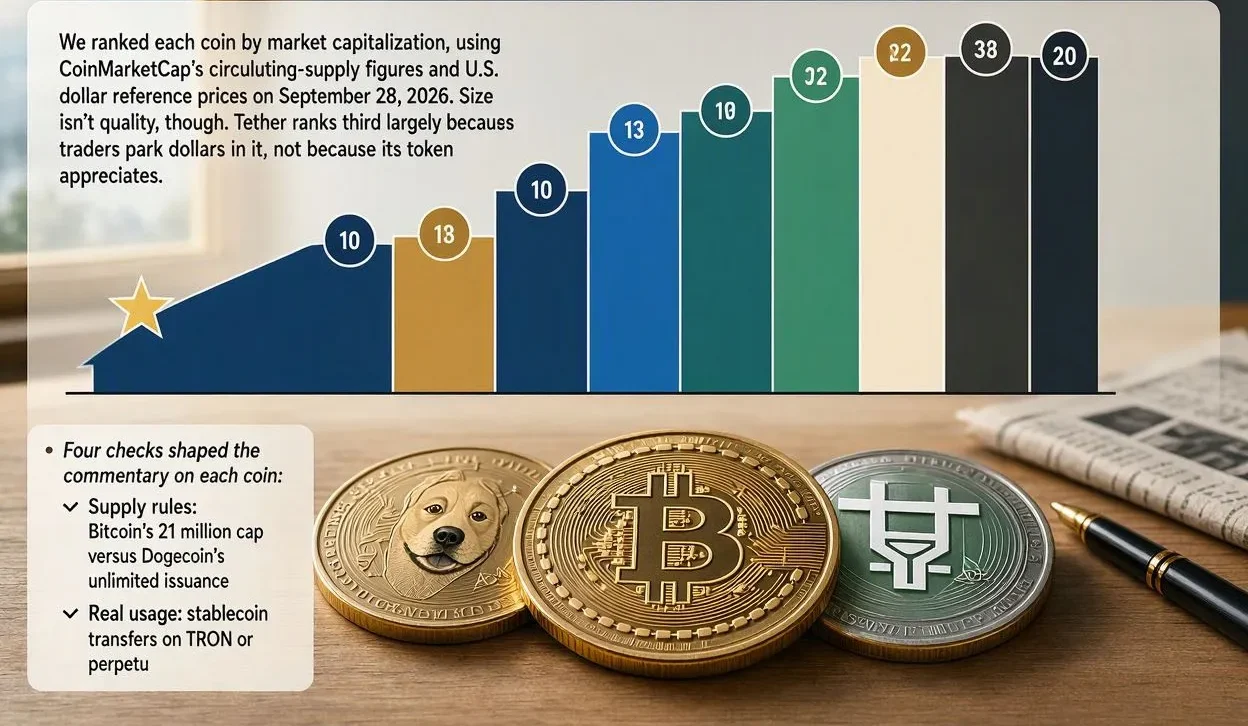
We ranked each coin by market capitalization, using CoinMarketCap’s circulating-supply figures and U.S. dollar reference prices on September 28, 2026. Size isn’t quality, though. Tether ranks third largely because traders park dollars in it, not because its token appreciates.
Four checks shaped the commentary on each coin:
- Supply rules: Bitcoin’s 21 million cap versus Dogecoin’s unlimited issuance
- Real usage: stablecoin transfers on TRON or perpetual futures volume on Hyperliquid
- U.S. access: exchange listings and spot exchange-traded funds (ETFs)
- Regulatory history: SEC lawsuits, settlements, and ETF approvals
Stablecoins stay in the main ranking. They’re among the largest crypto assets, after all, and a separate investable list drops them for anyone hunting growth.
The Top 10 Crypto Coins, Explained
1. Bitcoin (BTC)
Market cap: $1.66 trillion | Price: $83,069.45 | Launched: 2009
Bitcoin is the largest cryptocurrency and crypto’s main store-of-value asset, with a fixed supply of 21 million coins. Its creator, a person or group using the name Satoshi Nakamoto, put the software online in 2009 and dropped out of public view two years later. Roughly 20.09 million BTC exist right now. New coins come from mining: computers race to add each block under proof-of-work (PoW), and the winner has collected 3.125 BTC per block since the April 2024 halving. Our crypto mining calculator estimates what a mining rig earns today.
On paper, the price record still looks unreal. A coin that traded near $0.06 in July 2010 reached $126,198.07 on October 6, 2025, its 52-week high, and today’s $83,069 sits about 34% off that mark. You don’t have to buy a whole one. $100 gets you roughly 0.0012 BTC, which works out to 120,380 satoshis (sats), the smallest slice the network recognizes.
January 2024 changed who could own it. That month the Securities and Exchange Commission (SEC) approved 11 spot Bitcoin ETFs, so an IRA or a plain brokerage account suddenly had a way in. Critics keep hammering the power bill, and the U.S. Energy Information Administration (EIA) puts crypto mining at up to 2.3% of U.S. electricity use.
- Best for: people planning to hold for years who want the coin with the deepest market
- Watch out for: brutal bear markets (BTC lost 77% between November 2021 and November 2022)
2. Ethereum (ETH)
Market cap: $323.29 billion | Price: $2,648.11 | Launched: 2015
Ethereum is the leading smart contract platform, the network where most decentralized finance (DeFi) apps and dollar stablecoins run. Vitalik Buterin was 21 when he and his co-founders launched it in 2015. Every transaction costs a “gas” fee in ether (ETH); part of it gets burned, and validators keep the tip for processing the work.
Mining ended on Ethereum in September 2022. That switch, known as The Merge, moved the network to proof-of-stake (PoS) and cut its energy use by more than 99%. Because a slice of every fee is destroyed, ETH’s supply of about 122.08 million coins can shrink when the network gets busy.
Cheap everyday traffic has mostly moved to layer-2 networks such as Arbitrum and Base. Users are happy about the lower fees. ETH holders are less sure, since much of that activity pays the main chain very little, and the price shows the doubt: ETH sits roughly 44% below the $4,755.22 it hit on October 7, 2025.
- Best for: anyone who wants a stake in the plumbing that DeFi and tokenized assets run on
- Watch out for: Solana and other faster chains pulling users away
3. Tether (USDT)
Market cap: $183.74 billion | Price: $0.9995 | Launched: 2014
Tether is the largest stablecoin, a token built to hold a steady $1 value and used mainly for trading and moving dollars between platforms. Tether Ltd. mints the token on several chains, but TRON and Ethereum handle the bulk of it. Traders sell a coin into USDT, wait, and buy back in later without ever touching a bank.
Since USDT isn’t meant to rise, the real question is whether Tether can back every token. Its reserve disclosures drew heavy criticism for years, and only later did the company start publishing quarterly attestations. Washington stepped in with the Guiding and Establishing National Innovation for U.S. Stablecoins (GENIUS) Act in July 2025. It sets federal rules on reserves and disclosure for dollar stablecoins sold to Americans.
- Best for: traders who want to park dollars without leaving the crypto market
- Watch out for: total dependence on one private company’s reserves
4. BNB (BNB)
Market cap: $101.65 billion | Price: $763.00 | Launched: 2017
BNB is the native token of the Binance ecosystem, used to pay trading fees on Binance and gas fees on BNB Chain. It started in 2017 as a coupon for cheaper trading fees. These days it powers BNB Chain, one of the busiest smart contract networks by daily transactions.
Every quarter, Binance burns a batch of BNB for good, and about 133.15 million coins remain. Holders like the shrinking supply. The catch is that BNB rises and falls with a single company: Binance agreed to pay $4.3 billion to settle with U.S. authorities in November 2023, and Americans are limited to the separate Binance.US platform.
BNB topped out at $1,370.55 on October 13, 2025. It’s about 44% lower now.
- Best for: investors who don’t mind tying their money to one exchange’s fortunes
- Watch out for: new enforcement against Binance, which BNB’s price feels right away
5. XRP (XRP)
Market cap: $93.14 billion | Price: $1.47 | Launched: 2012
XRP is a payments token built to move money across borders in 3 to 5 seconds for a fraction of a cent. Ripple Labs pitches XRP as a bridge currency on the XRP Ledger. A bank sending money abroad converts into XRP, moves it, and converts out on the other side, so no cash has to sit idle in foreign accounts.
Ripple spent years in court. In December 2020 the SEC sued, claiming XRP sales were unregistered securities offerings, but a federal judge disagreed in July 2023 for XRP sold on public exchanges. The case closed in 2025. Spot XRP ETFs came next, and REX-Osprey’s XRPR became the first to trade in the U.S. in September 2025.
Supply is the weak spot. Ripple and its founders still hold a big chunk, and fresh XRP hits the market whenever Ripple decides to sell; 62.87 billion tokens circulate now.
- Best for: people who think banks will move cross-border payments onto a blockchain
- Watch out for: Ripple’s control over how much XRP reaches the market
6. USD Coin (USDC)
Market cap: $75.12 billion | Price: $0.9998 | Launched: 2018
USD Coin is a dollar-pegged stablecoin issued by Circle and backed by cash and short-term U.S. Treasury bills. An outside accounting firm checks Circle’s reserves, and Circle publishes the result every month. That’s a big reason U.S. institutions tend to pick USDC over Tether.
Coinbase supports it across its whole platform, so millions of Americans end up holding USDC by default. It has been tested exactly once. In March 2023, Circle had $3.3 billion of reserves at Silicon Valley Bank when the bank failed, and USDC dropped to about $0.87. It was back at $1 within days, after federal regulators guaranteed the bank’s deposits.
- Best for: keeping dollars on-chain with the clearest view of what backs them
- Watch out for: the banks and custodians holding the reserves (the 2023 depeg started there)
7. Solana (SOL)
Market cap: $69.75 billion | Price: $118.57 | Launched: 2020
Solana is a high-speed blockchain that handles thousands of transactions per second, usually for less than one cent each. Anatoly Yakovenko worked at Qualcomm before he built it. His design layers proof-of-history (PoH), a way of timestamping transactions, on top of proof-of-stake. Trades settle fast and cost next to nothing, which is why Solana became the main venue for meme coins and keeps gaining payments users.
All that speed came at a price. The network went down several times in 2021 and 2022, and critics still note that it runs on fewer validators than Ethereum. Big money came in anyway. Spot Solana ETFs started trading in late October 2025, and several of them stake the SOL they hold.
SOL costs $118.57 today. That’s about half of its $237.32 high from October 6, 2025.
- Best for: investors willing to take more risk for a faster Ethereum competitor
- Watch out for: outages, plus price moves that are often bigger than Bitcoin’s
8. TRON (TRX)
Market cap: $31.70 billion | Price: $0.3338 | Launched: 2017
TRON is a low-fee blockchain that carries a large share of the world’s USDT transfers, especially in emerging markets. Justin Sun started it in 2017 to share digital content. That plan faded. Stablecoin traffic took over instead, because a USDT transfer on TRON costs pennies and settles in seconds.
TRX covers network fees. Blocks come from 27 “super representatives” that token holders vote in, a setup called delegated proof-of-stake, and critics don’t love how concentrated that is. The SEC charged Sun in 2023 with alleged market manipulation involving TRX.
TRX bucks the pattern here. Most large coins peaked back in October 2025, but TRX set its 52-week high of $0.38 on May 26, 2026.
- Best for: investors who want a piece of stablecoin payment traffic
- Watch out for: how much power sits with Sun and a small group of validators
9. Zcash (ZEC)
Market cap: $26.13 billion | Price: $1,547.41 | Launched: 2016
Zcash is a privacy coin that uses zero-knowledge proofs to hide transaction details for users who choose shielded addresses. Researchers tied to MIT and Johns Hopkins started from Bitcoin’s original code to build it. It kept Bitcoin’s 21 million hard cap, and 16.89 million ZEC are in circulation.
Monero (XMR) hides everything by default. Zcash lets users decide, and CoinDesk Research estimates 20% to 25% of circulating ZEC is held in shielded addresses. This month the price moved quickly: ZEC touched $1,651.10 on September 23, 2026, and it now ranks above Dogecoin and Cardano.
Privacy draws regulators. Some exchanges restrict privacy coins in certain countries, so buying ZEC in the U.S. depends on your platform.
- Best for: buyers who care about financial privacy and like a hard supply cap
- Watch out for: a steep drop after such a quick climb, and possible exchange delistings
10. Hyperliquid (HYPE)
Market cap: $22.39 billion | Price: $89.14 | Launched: 2024
Hyperliquid is a decentralized exchange (DEX) for perpetual futures that runs on its own blockchain, and HYPE is the token behind it. After launching in November 2024, it grew into one of the largest on-chain derivatives venues. Professional traders like it because its order book runs at speeds close to a centralized exchange.
Since launch, HYPE is up about 2,790%. A large share of the exchange’s fees goes to buying HYPE on the open market, so more trading means more demand for the token.
It’s also the youngest coin here, with the shortest track record. As a derivatives platform, it draws scrutiny from the Commodity Futures Trading Commission (CFTC) that no other top 10 coin carries.
- Best for: experienced investors who already trade on DeFi platforms
- Watch out for: a short history and regulation aimed squarely at derivatives
Which Coins Make the Investable Top 10?
Dogecoin (DOGE) and Chainlink (LINK) replace Tether and USD Coin once stablecoins leave the ranking. A token pinned at $1 can’t deliver growth, so the next two coins by market cap fill the gap.
| Coin | Price (USD) | Market Cap | Why It Qualifies |
| Dogecoin (DOGE) | $0.09292 | $14.50 billion | Oldest meme coin, with deep liquidity and a large retail following |
| Chainlink (LINK) | $13.80 | $10.32 billion | Oracle network that feeds real-world data into smart contracts |
Dogecoin began as a joke in 2013. It has no supply cap, so new coins enter circulation every year, and its price moves mostly on social sentiment. Chainlink sits closer to infrastructure: AccuWeather and FedEx have both used its oracles to verify outside data. LINK gained about 10% over the past week, the strongest move among the 12 largest coins.
Which Coins Dropped Out of the Top 10 This Year?
Dogecoin and Cardano (ADA) fell out of the top 10 between March and September 2026, replaced by Zcash and Hyperliquid. In mid-March, Dogecoin ranked ninth near $15 billion and Cardano sat tenth near $13 billion. By September 28, Cardano had slid to 14th place at $9.02 billion.
Churn like this is normal. Binance USD (BUSD) held a top-10 spot until February 2023, when the New York Department of Financial Services (NYDFS) ordered Paxos to stop minting it. Polkadot (DOT), once a fixture, now trades near $1.23. A top-10 ranking is a snapshot, never a guarantee.
How to Evaluate a Crypto Coin Before You Buy
To evaluate a crypto coin, check 5 factors: liquidity, supply rules, real usage, security record, and regulatory status. Market cap shows size. These five show whether the size is earned.
- Check liquidity. Coins above $5 billion in market cap usually trade with tight spreads on major U.S. exchanges, while small coins can lurch on a single large order.
- Read the supply schedule. Maximum supply and scheduled token releases tell you how much new selling pressure is coming.
- Measure real usage. Transaction counts and fees paid reveal whether people use a network or just trade its token.
- Review the security record. Outages and exploits count against a network, and Solana’s 2021 and 2022 halts are a well-known case.
- Confirm regulatory status. Past SEC lawsuits and spot ETF approvals both signal how U.S. regulators treat a coin.
How to Buy the Top 10 Crypto Coins in the U.S.
To buy the top 10 crypto coins in the U.S., open an account on a regulated crypto exchange or buy a spot crypto ETF through a regular brokerage. Each route trades off control against convenience.
Buying Directly on a Crypto Exchange
To buy coins directly, sign up with a U.S.-licensed exchange, verify your identity, fund the account, and place an order. Coinbase, Kraken, Gemini, and Robinhood all list Bitcoin and Ethereum, though support for newer coins, such as HYPE, varies by platform. Know-your-customer (KYC) checks usually take anywhere from a few minutes to a day.
Owning coins outright lets you withdraw them to your own wallet. That matters more than most beginners think. When FTX collapsed in November 2022, customers waited more than two years for repayment. A hardware wallet, also called cold storage, keeps your private keys offline; lose the recovery phrase, though, and nobody can restore your funds. Compare models in our pick of the best cold wallet for crypto.
Buying a Spot Crypto ETF
To buy a spot crypto ETF, search the fund’s ticker in a brokerage account, including an individual retirement account (IRA), and buy shares like any stock. U.S. spot ETFs now cover Bitcoin, Ethereum, Solana, and XRP, among other coins. The SEC’s generic listing standards, approved in September 2025, sped up launches for newer assets.
Large Bitcoin ETFs typically charge expense ratios of 0.20% to 0.25% a year. You can’t withdraw the underlying coins, and shares only trade during stock market hours.
| Feature | Crypto Exchange | Spot Crypto ETF |
| What you own | The coins themselves | Shares of a fund |
| Trading hours | 24 hours, 7 days a week | 9:30 a.m. to 4:00 p.m. ET, weekdays |
| Self-custody option | Yes | No |
| IRA eligibility | Rarely | Yes, at most brokerages |
| Account protection | No FDIC or SIPC coverage for coins | SIPC coverage up to $500,000 if the brokerage fails |
| Coin selection | Hundreds of coins | Only coins with approved funds |
Neither route insures you against falling prices. Securities Investor Protection Corporation (SIPC) coverage only applies when a brokerage firm fails, and the Federal Deposit Insurance Corporation (FDIC) doesn’t insure crypto at all.
How Are Crypto Coins Taxed in the U.S.?
The IRS taxes crypto as property, so selling, swapping, or spending a coin creates a capital gain or loss. Coins held one year or less produce short-term gains, taxed at ordinary income rates. Long-term gains on coins held longer get rates of 0%, 15%, or 20%, depending on income.
Say you bought 1 SOL at $90 in March and sold it at $118.57 in September. That’s a $28.57 short-term gain.
Broker reporting changed in 2025 with Form 1099-DA, which listed gross proceeds for 2025 sales. Starting with 2026 transactions, brokers report cost basis as well, but only for coins bought on or after January 1, 2026, and held at the same broker until sale. The first forms with basis data arrive in early 2027.
Staking rewards count as ordinary income when you receive them, under IRS Revenue Ruling 2023-14. Swapping USDT for ETH is taxable too, even though no dollars reach your bank. Keep your own purchase records, since a broker has no idea what you paid for coins transferred in from another wallet.
What Are the Biggest Risks of Owning Crypto?

The 6 biggest risks of owning crypto are price volatility, custody failure, regulatory change, smart contract bugs, thin liquidity, and scams. A top-10 ranking removes none of them. To cut custody risk, read our hot wallet vs cold wallet guide.
- Price volatility: Between November 2021 and November 2022, Bitcoin lost about 77% of its value.
- Custody failure: When an exchange goes bankrupt, withdrawals stop, and FDIC insurance won’t cover you.
- Regulatory change: The Senate’s 49 to 50 cloture vote on September 15, 2026, stalled the Digital Asset Market Clarity (CLARITY) Act. That bill would have divided crypto oversight between the SEC and the CFTC.
- Smart contract bugs: Since 2020, coding flaws in DeFi apps have let attackers drain billions of dollars.
- Thin liquidity: Past the top 20, wide bid-ask spreads are common.
- Scams: The FBI’s Internet Crime Complaint Center (IC3) logged $9.3 billion in crypto fraud losses in 2024, much of it from fake giveaways and “pig butchering” schemes that pair a fake romance with a fake investment.
Position size is the simplest defense. Put in only what you can afford to lose. Dollar-cost averaging (DCA), buying a fixed dollar amount on a set schedule, spreads your entry price over time and takes the pressure off timing a peak
Conclusion
Bitcoin and Ethereum anchor the top 10 crypto coins, while the rest of the list changes often enough to need regular review. Two stablecoins hold their spots on size alone. Zcash and Hyperliquid, meanwhile, went from outsiders to top-10 members in about six months.
Pick coins you understand. Check the supply rules and the regulatory history before you buy, keep clean records for Form 1099-DA season, and size every position so a 50% drop won’t derail your plans.
Frequently Asked Questions

James
James leads crypto content at Crypto By Chance, covering exchanges, wallets, trading platforms, and blockchain technology. He researches trading fees, security features, market mechanics, and crypto regulations to explain a fast-moving market clearly. His guides and comparisons help readers evaluate their options, manage risk, and make informed decisions about digital assets.
Related Posts