Top 10 Crypto Wallets: Best Hot and Cold Picks for US Users
Disclosure: this page has no affiliate links. See how we review and rank.
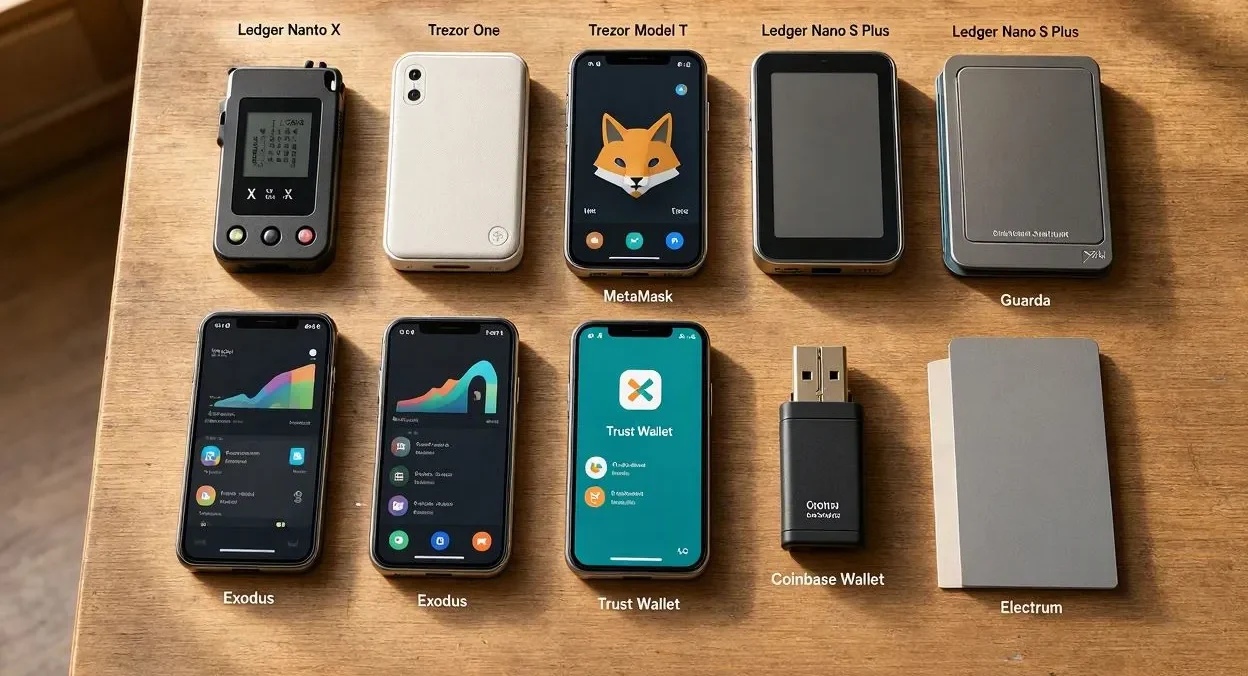
The top 10 crypto wallets for US users are Trezor Safe 5, Ledger Flex, Tangem, MetaMask, Coinbase Wallet, Phantom, Trust Wallet, Exodus, Sparrow, and Zengo. Three are hardware (cold) wallets built for long-term storage. The other seven are free software (hot) wallets for swaps and decentralized finance (DeFi) apps. Most people run two at once: a cold wallet holding savings and a hot wallet carrying spending money. Prices and network support reflect September 2026 data.
Top 10 Crypto Wallets Compared
| Rank | Wallet | Type | Price | Networks / Assets | In-App Swap Fee | Best For |
| 1 | Trezor Safe 5 | Cold, non-custodial | $129 | 9,000+ coins and tokens | Partner rates | Most long-term holders |
| 2 | Ledger Flex | Cold, non-custodial | $249 | 5,500+ coins and tokens | Partner rates | Multi-asset holders who want a big screen |
| 3 | Tangem | Cold, NFC card | $54.90 (2 cards) / $69.90 (3 cards) | 16,000+ assets | Partner rates | Budget buyers, seedless setup |
| 4 | MetaMask | Hot, non-custodial | Free | EVM networks, Solana, Bitcoin, Tron | 0.875% | Ethereum and DeFi |
| 5 | Coinbase Wallet | Hot, non-custodial | Free | 10+ networks | Not published | Beginners |
| 6 | Phantom | Hot, non-custodial | Free | 7 networks | 0.85% | Solana users |
| 7 | Trust Wallet | Hot, non-custodial | Free | 100+ blockchains | Varies by route | Mobile-first users |
| 8 | Exodus | Hot, non-custodial | Free | 300+ assets | Spread built into quote | Desktop portfolio tracking |
| 9 | Sparrow | Hot, Bitcoin-only desktop | Free | Bitcoin | No swaps | Bitcoin-only holders |
| 10 | Zengo | Hot, MPC | Free (paid Pro tier) | 380+ assets | Varies by route | Seedless recovery |
How We Ranked These Wallets

Not sure which type you need? Start with our hot wallet vs cold wallet guide. We scored each of the top 10 crypto wallets on 5 weighted factors:
- Security (35%): key storage, audits, open-source status, and incident history.
- Network and asset support (20%): the chains and tokens each wallet handles natively.
- Fees (15%): swap service fees and hardware prices.
- Ease of use (15%): setup time, screen clarity, and support access.
- Recovery options (15%): seed phrase, Shamir Backup, or multi-party computation (MPC).
Data came from 4 source types: official product documentation, published fee schedules, third-party security ratings (CertiK Skynet and CER.live), and public incident reports from December 2025 through September 2026. Security carries the heaviest weight. A clean interface can’t make up for a weak key model.
The 10 Best Crypto Wallets, Ranked
1. Trezor Safe 5: Best Cold Wallet for Most People
Trezor Safe 5 is the best cold wallet for most buyers because it pairs an EAL6+ (Evaluation Assurance Level 6+) secure element with fully open-source firmware for $129. Anyone can audit that code. Its 1.54-inch (3.9 cm) color touchscreen displays an entire receiving address at once, which cuts the risk of approving a swapped address. The device measures 65.9 x 40 x 8 mm (2.59 x 1.57 x 0.31 in) and supports Shamir Backup, which splits recovery into several shares so no single sheet can restore the wallet.
It isn’t wireless. Trezor’s official US offers in mid-September 2026 were $129 for the Safe 5 and $249 for the Safe 7, and that $120 gap pays for wireless connectivity, a larger screen, and different hardware. Budget buyers can drop to the $59 Safe 3, which keeps the same secure element but uses a smaller monochrome screen.
2. Ledger Flex: Best Touchscreen Hardware Wallet
Ledger Flex is the top pick for holders of many different coins who want a large screen and Bluetooth signing, at $249. It uses a 2.84-inch (7.2 cm) E Ink touchscreen under Gorilla Glass, and both Flex and Stax support more than 5,500 coins and tokens through Ledger Live. Clear Signing translates smart contract requests into readable text before you approve them. Buyers of the Flex, Nano Gen5, or Stax also get a Ledger Recovery Key card, normally a $39 item, at no extra cost.
Cheaper models exist. Ledger’s support site lists the Nano X at $99 and the Nano S Plus at $59. The Nano X runs an older EAL5+ chip, a step below the EAL6+ chip shared by the Nano S Plus, Flex, and Stax. Ledger’s operating system is closed-source, and the company disclosed and patched several wallet-app vulnerabilities in late August 2026. Update through Ledger Live before signing anything.
3. Tangem: Best Budget Seedless Hardware Wallet
Tangem is the cheapest path into cold storage, at $54.90 for a two-card set or $69.90 for three. Each card holds an EAL6+ chip that generates and stores the private key. To sign a transaction, you tap the card against a phone with NFC (near-field communication). There’s no battery, cable, or screen to maintain.
The seed phrase is optional. Backup cards carry copies of the same key, so losing one card doesn’t lock you out. Tangem supports 16,000+ assets, and its firmware has passed audits by Kudelski Security and Riscure. The tradeoff is real, though: you review transaction details on your phone, not on the device, and there’s no desktop app.
4. MetaMask: Best Wallet for Ethereum and DeFi

MetaMask is the default wallet for Ethereum apps, and it now signs natively on Solana, Bitcoin, and Tron from a single recovery phrase. Solana support arrived in May 2025, Bitcoin in December 2025, and Tron in January 2026. Developers building a decentralized app (dApp) on Ethereum almost always integrate MetaMask first, so connection failures are rare.
Convenience costs money here. MetaMask charges 0.875% on swaps, and staking, prediction markets, perpetuals, and its card product each carry separate fees. US users also can’t stake ETH inside the app. Pair it with a Trezor or Ledger once your balance grows past what you’d carry in a physical wallet. Network costs come on top; check them first with our gas fee calculator.
5. Coinbase Wallet: Best Crypto Wallet for Beginners
Coinbase Wallet is the easiest self-custody wallet for beginners, especially anyone already holding crypto on the Coinbase exchange. The name may confuse you. Coinbase announced on September 10, 2026 that the Base App would return to the Coinbase Wallet name, undoing the July 2025 rebrand. Older guides still say “Base.”
The app stays self-custodial, so you keep your own keys, and Coinbase says it detects and hides scam or malicious tokens. Coverage reaches more than 10 blockchain networks. One gap stands out. Coinbase earns revenue through trading and product fees but declined to share the fee structure.
6. Phantom: Best Wallet for Solana
Phantom is the best Solana wallet, with roughly 39% of Solana’s wallet market and more than 15 million active users. Swaps, SOL staking, and NFT (non-fungible token) management all sit in one app.
Its network list keeps shifting. As of September 9, 2026, Phantom supported Solana, Ethereum, Base, Polygon, Robinhood Chain, Bitcoin, HyperEVM, and Sui, after dropping Monad on August 26 and scheduling Sui support to end on September 24, 2026. That leaves 7 networks today. Phantom charges a flat 0.85% on every in-app swap. BNB Smart Chain, Arbitrum, and Avalanche aren’t supported, and neither are custom networks.
7. Trust Wallet: Best Mobile Multichain Wallet
Trust Wallet is the best mobile-first multichain wallet, covering 100+ blockchains and more than 10 million assets from a phone. Binance owns it. Its built-in Security Scanner flagged over $191 million in potentially harmful transactions during 2025.
The browser extension has a scar. A malicious extension version, 2.68, reached the Chrome Web Store on December 24, 2025, most likely through a leaked API key, and it caused about $7 million in losses. Desktop extension users were hit, while the mobile app was spared. Binance co-founder Changpeng Zhao said victims would be reimbursed. Stick to the mobile app, and keep any extension updated.
8. Exodus: Best Desktop Portfolio Wallet
Exodus is the best desktop wallet for tracking a multi-coin portfolio, with apps for Windows, macOS, Linux, iOS, and Android. Balances, price charts, and allocation share one screen. Google Play shows a 4.5/5 rating from about 128,000 reviews, and the App Store shows 4.6/5 from about 33,000.
Hardware pairing works both ways. Ledger Nano X and Flex connect to Exodus Mobile, the Trezor Model One, Model T, Safe 3, and Safe 5 connect to the desktop app, and the Safe 7 uses mobile. Two weaknesses: built-in swaps carry wider spreads than dedicated exchanges, and the full application isn’t open source.
9. Sparrow: Best Bitcoin-Only Wallet
Sparrow is the best Bitcoin-only wallet for users who want full control over fees, individual coins, and privacy. It’s a free, open-source desktop app for Windows, macOS, and Linux. You can route it through your own Bitcoin Core node, a private server, or a public one.
Power users get coin control, multisig setups with hardware wallets such as Trezor and Ledger, and PSBT (Partially Signed Bitcoin Transaction) support. Its transaction editor doubles as a blockchain explorer. There’s no mobile app, no token swaps, and no fiat on-ramp. Skip it if you hold anything besides BTC.
10. Zengo: Best Seedless Hot Wallet
Zengo is the best seedless hot wallet because MPC splits the key between your phone and Zengo’s servers, leaving no 12- or 24-word phrase to lose. Recovery combines email, an encrypted cloud recovery kit, and 3D FaceLock biometrics, and eToro Group completed its acquisition of Zengo in 2026.
Inheritance is its quiet strength. Zengo Pro’s Legacy Transfer lets you name one recipient and set an inactivity timer, commonly between 3 and 24 months. The catch: the client code is closed source, and signing depends on Zengo’s infrastructure staying online. It’s mobile-only.
Hot Wallet vs. Cold Wallet: Which One Do You Need?
Most US crypto holders need both: a cold wallet for savings and a hot wallet for daily transactions. Hot wallets are free apps that stay online. MetaMask and Phantom connect to dApps in seconds, and that constant connection exposes them to malware and malicious approvals.
Cold wallets keep private keys on offline hardware. The Trezor Safe 5 and Ledger Flex require a physical button press or screen tap before any transaction leaves the device, so a hacker needs the device itself plus its PIN. Buy a cold wallet once your holdings exceed what you’d accept losing in a single phishing attack.
Custodial vs. Non-Custodial Wallets
A non-custodial wallet gives you sole control of the private keys, while a custodial wallet leaves them with a company such as an exchange. Every wallet in this top 10 crypto wallets list is non-custodial. Coinbase Wallet belongs here too, because its keys stay on your device even though the Coinbase exchange account doesn’t work that way. If you prefer a custodial account, compare the top 10 crypto exchanges.
Custody matters most during failures. FTX, BlockFi, and Voyager customers lost access to funds once those companies filed for bankruptcy. Crypto held in any wallet carries no FDIC (Federal Deposit Insurance Corporation) or SIPC (Securities Investor Protection Corporation) coverage.
How to Choose a Crypto Wallet
To choose a crypto wallet, match it to the coins you hold, how often you transact, and how much you’re protecting. Work through these 4 checks:
- Confirm network support. Phantom skips BNB Smart Chain, and Sparrow handles only Bitcoin.
- Estimate transaction frequency. Weekly DeFi users need a hot wallet, while yearly buyers can live on hardware alone.
- Size your balance. Holdings above $500 justify a $54.90 to $129 hardware wallet.
- Pick a recovery model. Seed phrases suit careful record-keepers, and MPC suits people who’ve lost passwords before.
How to Set Up a Crypto Wallet Safely
To set up a crypto wallet safely, get it from the official source, back up the recovery phrase offline, and test with a small transfer first. For every step in detail, see how to create a crypto wallet. Follow these 5 steps:
- Buy hardware direct. Order from the manufacturer or an authorized reseller such as Best Buy, never from a third-party marketplace listing.
- Download apps from official links. Fake wallet apps copy logos and names in app stores.
- Write the recovery phrase on paper or steel. Never photograph it, type it into a notes app, or store it in cloud email.
- Add a BIP-39 passphrase for large balances. BIP-39 (Bitcoin Improvement Proposal 39) supports an optional extra word, often called the 25th word, that creates a separate hidden wallet.
- Send a test transaction. Move $10 to $20 first, confirm it arrives, then send the rest.
5 Security Mistakes That Empty Crypto Wallets
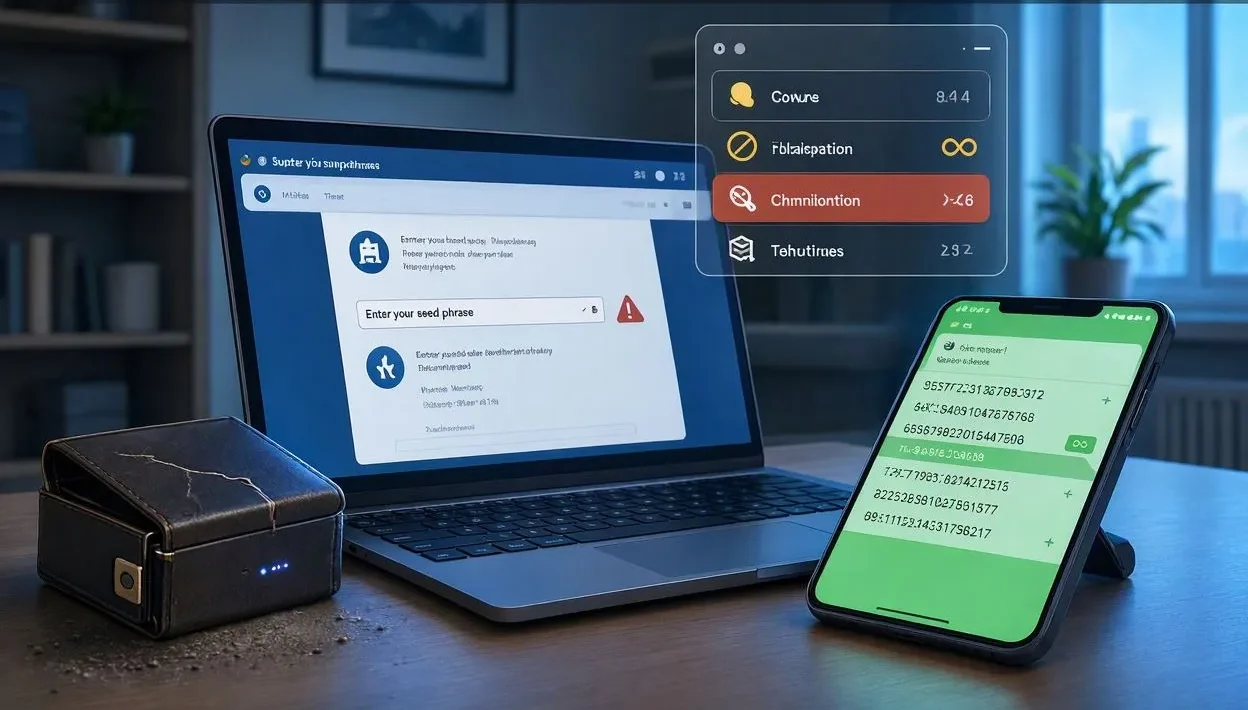
These 5 mistakes cause more wallet losses than broken encryption does:
- Copying addresses from transaction history. Address poisoning attacks send tiny amounts from look-alike addresses, hoping you’ll paste the wrong one later.
- Leaving unlimited token approvals active. Old DeFi permissions let a hacked contract drain tokens, so revoke them with a tool such as Revoke.cash.
- Entering a seed phrase on a “support” site. During the Trust Wallet breach, fake domains such as fix-trustwallet.com pushed panicked users to type in seed phrases.
- Ignoring clipboard malware. US and European authorities, working with CrowdStrike, took down the Sality botnet in September 2026 after it swapped copied crypto addresses on more than 15,000 infected computers.
- Running outdated extensions or firmware. Ledger’s August 2026 vulnerabilities were reproduced only against an outdated Ethereum app version.
Do Crypto Wallets Change Your Taxes?
No, the wallet doesn’t change what you owe, but it changes what the IRS (Internal Revenue Service) receives about you. Custodial exchanges now file Form 1099-DA. For sales made on or after January 1, 2025, brokers report gross proceeds, and those forms reached taxpayers in early 2026. Cost basis reporting starts with 2026 transactions.
Self-custody works differently. Congress repealed the DeFi broker rule in April 2025, keeping self-custody wallets and DEX front-ends out of the 1099-DA system. Taxes still apply, though. Swaps on a decentralized exchange (DEX), sales from a self-custody wallet, and peer-to-peer trades remain taxable and must be self-reported. Transfers between your own wallets aren’t disposals, yet they can still show up as proceeds on a 1099-DA. Label each one as a transfer in your records. This is general information, not tax advice.
How to Pass Crypto to Your Heirs
To pass crypto to your heirs, leave written access instructions in a secure location your executor can reach, separate from your will. Wills become public during probate in most US states, so a seed phrase written into one is exposed.
Two built-in tools help. Zengo Pro’s Legacy Transfer hands wallet access to a named recipient after a set period of inactivity. Trezor’s Shamir Backup splits recovery into multiple shares, so you can give one share each to 2 or 3 trusted people and require a set number of them to restore access. An estate attorney can connect either method to a formal plan.
Conclusion
The best setup for most US users pairs one hardware wallet with one hot wallet. Choose the Trezor Safe 5 for open-source cold storage at $129, or Tangem if budget matters most. For daily use, choose MetaMask on Ethereum, Phantom on Solana, or Coinbase Wallet as a first step off an exchange.
These top 10 crypto wallets each fit a different job. None of them protects against a leaked seed phrase or a rushed signature, though. Back up offline, verify every address on the device screen, and keep records of each wallet-to-wallet transfer before tax season arrives.
FAQs

James
James leads crypto content at Crypto By Chance, covering exchanges, wallets, trading platforms, and blockchain technology. He researches trading fees, security features, market mechanics, and crypto regulations to explain a fast-moving market clearly. His guides and comparisons help readers evaluate their options, manage risk, and make informed decisions about digital assets.
Related Posts