Binance vs Coinbase: How to Pick the Right Exchange for You
Binance vs Coinbase comes down to location first, then cost. Global Binance wins on fees and coin choice, but US residents cannot use it. Coinbase wins on US access, regulation, and beginner ease, while Binance.US wins on US spot fees. This guide compares fees, coins, safety, staking, tax, and wallets so you can pick the right exchange.
Key Takeaways
- Binance vs Coinbase is a location question first: global Binance is closed to US residents, so US traders compare Coinbase with Binance.US.
- Binance fees vs Coinbase fees favour Binance on spot trades, and Binance.US charges 0% maker and 0.02% taker on every pair.
- Coinbase is the simpler start for beginners, with US regulation, phone support, and Form 1099-DA tax reporting.
- Binance lists around 500 coins globally, while Binance.US lists 190+ coins and Coinbase supports hundreds of assets.
- Neither exchange is a SIPC member, so crypto held on either platform lacks SIPC protection.
Binance vs Coinbase: Which Is Better?
Binance wins on fees and coin choice, while Coinbase wins on US access and beginner ease. The right pick depends on where you live and how you trade. US residents must choose between Coinbase and Binance.US, not global Binance. Frequent traders outside the US save more with Binance. Beginners in the US get a simpler start with Coinbase.
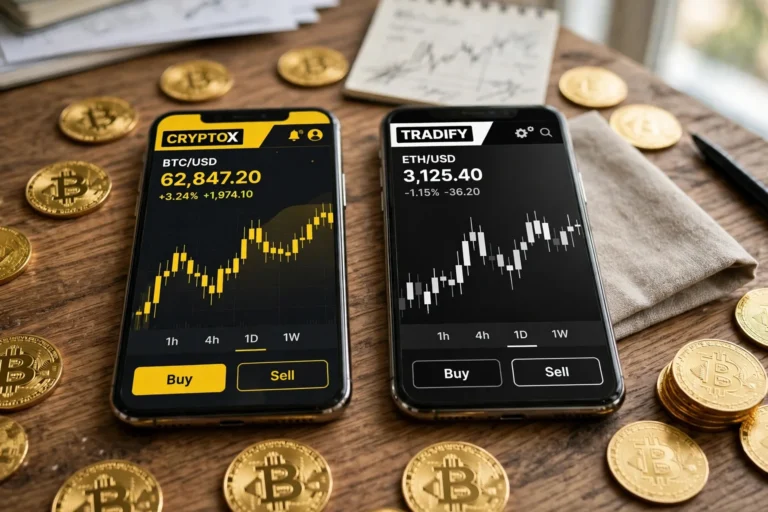
Coinbase feels calmer for a first purchase, with big buy and sell buttons and short steps. Binance packs more screens, charts, and order types into the same space, which helps traders who know order books and overwhelms new buyers.
Is Binance better than Coinbase for active traders? Yes, outside the US. Global Binance charges 0.10% on spot trades, lists around 500 coins, and runs futures, options, margin, and Launchpad sales. Coinbase answers with a cleaner app, US regulation, and a Nasdaq listing.
Coinbase vs Binance also splits on trust signals. Coinbase files audited reports and operates in all 50 US states. Binance paid a $4.3 billion settlement to the US Department of Justice (DOJ) in 2023 and operates under a compliance monitor through 2028. Its founder, Changpeng Zhao, resigned as chief executive officer (CEO) after that settlement and was pardoned in October 2025.
| Feature | Binance (global) | Binance.US | Coinbase |
|---|---|---|---|
| US access | No, closed to US residents | Yes, 40 US jurisdictions | Yes, all 50 states |
| Spot fees at entry | 0.10% maker / 0.10% taker | 0% maker / 0.02% taker | 0.50% maker / 0.90% taker on Advanced in the US |
| Coins | Around 500 | 190+ | Hundreds of assets |
| Derivatives | Full futures, options, and margin suite | No futures or margin trading | CFTC-regulated perpetual-style futures in the US since July 2025, up to 10x |
| Best for | Active traders outside the US | US traders who want low spot fees | Beginners and US users who want simple access |
Is Binance Allowed in US?
No, global Binance is not allowed in the US, but Binance.US serves US residents in most states. US residents cannot open a Binance.com account. Binance.US is a separate exchange with fewer coins and no futures or margin trading. It is unavailable in 12 states and 4 territories, including New York, Texas, North Carolina, and Georgia.
Can Binance be used in the US? Not the global platform. That point trips up many new traders, because search results mix global Binance with Binance.US. The two exchanges share a brand and some design, but they run as separate companies with separate coin lists, fees, and rules. A trader who signs up for the wrong one hits a wall at verification, or finds a coin missing after funding an account.
Check your state before you fund anything. Binance.US lists 40 US jurisdictions, which means 38 states plus the District of Columbia (DC) and Puerto Rico, as of June 2026. Kansas and Wisconsin can trade crypto but cannot use US dollar (USD) services. New York, Texas, North Carolina, and Georgia are among the states where Binance.US does not operate. Coinbase, by contrast, is available in all 50 states, including Hawaii and New York, where crypto rules are strict.
What happened with US regulators?
In 2023, Binance settled with US authorities for $4.3 billion, and its founder stepped down. The Securities and Exchange Commission (SEC) dismissed its case against Binance with prejudice in May 2025. Coinbase had its own fight with the SEC, and in February 2025 it announced that the SEC had agreed to drop a lawsuit that accused Coinbase of running an illegal exchange.
For UK readers, the picture flips again. Coinbase is registered with the Financial Conduct Authority (FCA) in the UK, while Binance is not FCA regulated in the UK. Pick the version that matches your address, then check the exchange site on the day you sign up.

Binance Fees vs Coinbase: Which Costs Less?
Binance costs less than Coinbase for most spot trades, and Binance.US costs less than both in the US. Global Binance charges 0.10% maker and 0.10% taker, with a 25% cut when you pay in BNB. Binance.US charges 0% maker and 0.02% taker on every pair. Coinbase Advanced starts at 0.50% maker and 0.90% taker in the US.
Binance vs Coinbase fees look close on a single trade, then widen with volume. A $1,000 spot buy at 0.10% costs $1 in fees on global Binance. The same buy on Coinbase Advanced at 0.90% taker costs $9. On Binance.US at 0.02% taker, it costs $0.20. Those gaps compound for a trader who buys and sells each week. A beginner who buys $100 once a month will feel the gap less, and may value a simple screen more than a $0.80 saving.
Watch the simple trading screen on Coinbase. It charges a spread on the price plus a separate fee of up to 1.875%, and it shows both in the order preview before you confirm. Coinbase Advanced is the cheaper route for the same coins, with tiered fees that fall as 30-day volume rises. Binance also cuts fees when you pay in BNB, its own token, by 25% on global Binance.
Binance fees vs Coinbase fees at a glance
| Fee | Binance (global) | Binance.US | Coinbase |
|---|---|---|---|
| Spot maker / taker at entry | 0.10% / 0.10% | 0% / 0.02% | 0.50% / 0.90% on Advanced in the US |
| Pay in BNB | 25% off | 5% off spot fees, 0.01% taker on BNB/USD | No BNB discount |
| Simple buy screen | Not the main route | Not the main route | Spread plus fee up to 1.875% |
| Wire transfer deposit | Free on Binance in the Investopedia table | $0 from Binance.US, bank fees may apply | $10 on each wire-transfer deposit |
| Wire transfer withdrawal | Free on Binance in the Investopedia table | $25 flat fee, bank fees may apply | $25 |
| ACH transfer | Free | Free for deposits and withdrawals | Free |
Binance.US fiat fees come from the Binance.US buy page, checked in November 2026.
Staking fees add a second cost layer. Investopedia lists staking fees of 30% to 39.95% on Binance, against 25% to 35% on Coinbase. Those percentages are the cut taken from staking rewards, not the return itself. A high headline annual percentage yield (APY) means less after that cut, so compare net returns, not headline rates alone.

Which Exchange Is Safer: Binance or Coinbase?
Coinbase is safer for US users on custody and regulation, while Binance relies on its Secure Asset Fund for Users (SAFU) reserve. Neither exchange is a Securities Investor Protection Corporation (SIPC) member, so crypto on either platform has no SIPC cover. On both, keep long-term holdings in a self-custody wallet.
Cold storage (offline wallets): Coinbase keeps most customer crypto offline, with biometric access and insurance on assets held in custody. Binance keeps more than 95% offline and uses withdrawal whitelists.
Hacks: Binance lost $40 million in a 2019 hack and repaid users from SAFU. Coinbase has never lost customer funds to a breach.
Data breach: In May 2025, attackers bribed overseas support contractors and took personal data on about 69,500 Coinbase customers. No passwords, private keys, or funds were taken, but scammers used the data to trick some customers into sending crypto. Coinbase put reimbursement and security upgrades at $180 million to $400 million. Support staff, not code, can be the weak point.
Coinbase regulation: Nasdaq-listed, audited financial statements, and US rules followed in every state it serves.
Binance regulation: a compliance monitor through 2028 after its 2023 settlement, and licences in Dubai, France, Italy, Spain, Bahrain, Japan, and Australia. Blockworks reports a possible European Union (EU) exit after Binance missed a Markets in Crypto-Assets (MiCA) licence.
Choose Coinbase for one clear regulator, and Binance for low fees.
Safety checklist before you deposit
- Turn on two-factor authentication (2FA) on day one, and use an authenticator app, not short message service (SMS) codes alone.
- Keep most holdings offline in a wallet you control, and keep only trading funds on an exchange.
Coinbase vs Binance: Which Lists More Coins and Products?
Binance lists more coins and products than Coinbase, with around 500 coins on its global platform. Coinbase supports hundreds of assets but does not publish a single headline count. Binance.US lists 190+ coins. Binance adds futures, options, margin, and Launchpad token sales, while Coinbase focuses on spot trading, staking, and its Base network.
Coin count alone can mislead. Binance lists tiny altcoins and new decentralised finance (DeFi) tokens that Coinbase will not list, because Coinbase vets coins more strictly. Binance.US sits in the middle, with 190+ coins, fewer than global Binance by a wide margin.
Product range splits the same way. Binance runs the most extensive futures platform, with US dollar (USD)-margined, coin-margined, and delivery futures, plus margin, options, peer-to-peer (P2P) trading, savings, and an NFT marketplace. Coinbase has narrowed the gap. After acquiring Deribit in 2025, Coinbase became one of the largest crypto derivatives venues in the world, with CFTC-regulated perpetual-style futures in the US since July 2025.
Coins, staking, and special features compared
| Feature | Binance (global) | Binance.US | Coinbase |
|---|---|---|---|
| Coins listed | Around 500 | 190+ | Hundreds, no single headline count |
| Futures and margin | Full suite | No futures or margin | CFTC perpetual-style futures in the US, wider market outside the US |
| Staking | Simple Earn, flexible and locked products | Staking on roughly 30 assets | Staking on major assets, including Ethereum, Solana, and Cardano |
| Extras | NFT marketplace, Launchpad, P2P | Advanced charting, many order types | Coinbase Card, Earn rewards, Vault, Base network |
| Wallet | Binance Web3 Wallet | Binance.US wallet | Coinbase Wallet |

Binance vs Coinbase Staking: Which Pays More?
Binance pays the higher headline staking APY, up to 14.90% against 13% on Coinbase, but Coinbase takes a smaller fee cut and covers more major assets. Investopedia lists Binance staking fees of 30% to 39.95% and Coinbase staking fees of 25% to 35%. Compare net returns, not headline APY.
The fee is a cut of your rewards, so it changes the winner. At the highest Binance fee, a 14.90% headline APY leaves about 8.95%. At the lowest Coinbase fee, a 13% headline APY leaves 9.75%. No page gives a clean net APY for the same coin on both exchanges, so open the staking page for the coin you hold, read the fee, and work out the net return before you lock funds.
Asset choice differs by platform. Coinbase stakes Ethereum (ETH), Solana (SOL), and Cardano (ADA). Global Binance runs flexible and locked Simple Earn products plus dedicated ETH and SOL staking. Binance.US offers staking on roughly 30 assets.
US state rules limit Coinbase staking. California, Maryland, New Jersey, and Wisconsin still cannot make new staking deposits, and rewards there stop compounding. Coinbase launched staking in New York after receiving state approval.
Locked staking pays more than flexible staking but ties up your funds for a set period. Flexible staking pays a lower rate and lets you withdraw sooner.
Binance vs Coinbase Tax Reporting: What Forms Do You Get?
Coinbase and Binance.US both send Form 1099-DA to US customers and the Internal Revenue Service (IRS), while global Binance does not. Coinbase also sends Form 1099-MISC for staking and rewards income. For the 2025 tax year, Form 1099-DA reports gross proceeds but not cost basis, and cost-basis reporting starts with the 2026 tax year.
An exchange form covers that platform only. It misses anything you did after moving crypto elsewhere, and without cost basis it can make gains look far larger than they were. Many investors close that gap with third-party crypto tax software.
Each exchange gives you different records:
- Coinbase: a gain and loss report that shows cost basis, plus Form 1099-DA and Form 1099-MISC.
- Binance.US: a downloadable comma-separated values (CSV) file of capital gains and losses, plus Form 1099-DA.
- Global Binance: no US tax forms, because it does not serve US customers. A US trader who uses it through a workaround still owes tax on gains.
Keep your own records from day one:
- Save the CSV export from each exchange.
- Note the date and price of every buy and sell.
- Record every transfer between wallets.
Clean records save hours at tax time and prove your cost basis if the IRS asks.

Which Wallet Should You Use: Coinbase Wallet or Trust Wallet?
Use Coinbase Wallet if you trade on Coinbase, and Trust Wallet if you trade on Binance and want wider chain support. Both are self-custody wallets, so you control the private keys. Exchange wallets suit quick trades, while self-custody wallets suit long-term holds. For large sums, move most holdings to a wallet you control.
Exchange wallets and self-custody wallets solve different problems. An exchange wallet holds crypto on the exchange, so you can trade fast, but the exchange holds the keys. A self-custody wallet holds the keys with you, so you can move crypto without asking an exchange, but you must guard the recovery phrase. Lose that phrase, and you lose access.
Coinbase Wallet is a separate app from the Coinbase exchange app. It supports Bitcoin, Ethereum, Solana, Dogecoin, and more, and it connects to DeFi apps. Trust Wallet, linked to Binance, supports a wide range of chains and tokens, and it suits traders who hold many small altcoins. Binance also offers Binance Web3 Wallet inside its app, while Coinbase offers Vault, a storage feature with extra approval steps for large withdrawals.
For small, frequent trades, an in-app wallet is fine. For long-term holds, a personal wallet, software or hardware, cuts reliance on any exchange. Many investors keep a portion on a platform for speed, and move the bulk offline.
Coinbase One, Coinbase Card, and Deposit Limits: What Competitors Skip
Coinbase One, Coinbase Card, deposit times, daily limits, and account-lock steps are the costs and risks most exchange comparisons skip. No verified source in this review prices Coinbase One, compares Coinbase Card with Binance options, or lists transfer times and hold periods. Active traders feel these gaps most, so check each item yourself before you fund an account.
Coinbase One break-even
Coinbase One is a subscription, so it pays off only when the fees you save exceed the monthly price. No verified page gives its price, fee discount, or break-even trade volume. If you trade weekly on Coinbase Advanced, add up your monthly fees at your volume with and without Coinbase One, then compare both totals with Binance.US at 0% maker and 0.02% taker.
Coinbase Card
Coinbase Card lets you spend crypto. No verified page compares it with Binance card or peer-to-peer (P2P) options, so read the current card terms on each exchange before you rely on either.
Deposit and withdrawal methods
Coinbase supports Automated Clearing House (ACH) transfers, wire transfers, debit cards, bank accounts, PayPal, Apple Pay, and Google Pay. Binance supports bank transfers, cards, P2P Express, and online banking, with fees that vary by region. No verified page gives ACH times, wire times, daily limits, or hold periods for either exchange.
Network fees
Exchange fees are only part of the cost of moving crypto. On-chain withdrawal fees, network congestion, and your chosen coin all change the amount you receive, so compare the full path from deposit to trade to withdrawal.
Account locks
Both exchanges can freeze an account during a know your customer (KYC) recheck, a large deposit, or a security review. No verified page gives response times or a step-by-step path to reopen a locked account. Coinbase offers phone support for locked accounts, while Binance relies mostly on tickets and live chat. Keep your identity documents ready, keep a second way to reach support, and spread your funds across more than one exchange.

Which Exchange Should You Choose?
Choose Coinbase if you live in the US and want simple buying, strong regulation, and phone support. Choose Binance.US if you live in a supported US state and want the lowest spot fees. Choose global Binance only if you live outside the US and want the widest coins and products. Many traders use two exchanges for different goals.
Start with your address, not with fees.
If you live in the US
Global Binance is closed to US residents, so the real choice is Binance.US vs Coinbase. Binance.US does not operate in New York, Texas, North Carolina, or Georgia, so Coinbase is the practical pick there. In a supported state, Binance US vs Coinbase fees decide it for frequent traders, because Binance.US at 0% maker and 0.02% taker saves money on every trade. Monthly traders who want a simple app will find Coinbase easier, even at a higher fee.
If you live outside the US
Global Binance offers lower fees, more coins, and more products, from futures to Launchpad sales. Coinbase charges more and lists fewer coins, but it wins on simple buying, clear regulation, and a clean app. Pick Binance for altcoins and advanced orders. Pick Coinbase for a simple first buy on a regulated platform.
By trader type
- Beginners: pick the exchange you can use without help, usually Coinbase in the US.
- Active traders: pick the exchange with the lowest fees for your volume and your coins.
- Long-term holders: pick the exchange with the strongest custody record, then move most holdings to a wallet you control.
Conclusion
Location decides the shortlist, and trading style decides the winner. US traders compare Coinbase and Binance.US, because global Binance is closed to them. Traders outside the US can add global Binance, whose lower fees and wider coin list often win on cost alone. Beginners in the US get the most from Coinbase, with its simple app, clear regulation, and phone support. Active traders in a supported US state save the most on Binance.US, at 0% maker and 0.02% taker spot fees, while active traders outside the US get low fees, around 500 coins, and futures on global Binance.
Fees, state access, coin lists, and tax forms keep changing. Coinbase Advanced fees changed in September 2026, Binance.US fees changed in April 2026, and Form 1099-DA rules change with the tax year. Check the fee page, state list, and staking page on the day you trade, and keep your own records for tax.
FAQs

James
James leads crypto content at Crypto By Chance, covering exchanges, wallets, trading platforms, and blockchain technology. He researches trading fees, security features, market mechanics, and crypto regulations to explain a fast-moving market clearly. His guides and comparisons help readers evaluate their options, manage risk, and make informed decisions about digital assets.
Related Posts